Venice.ai: A Private, Permissionless AI Platform :>
Introduction :>
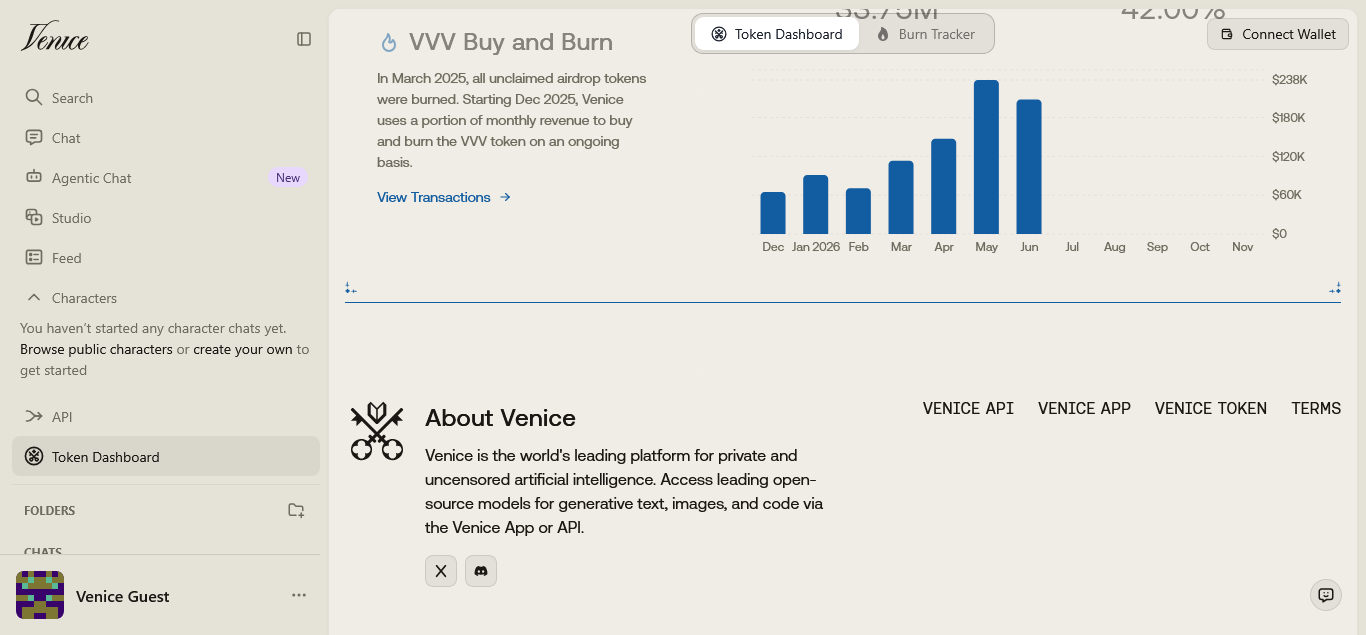
Venice.ai is a generative artificial intelligence platform designed to provide users with private, uncensored access to advanced AI models for text, image, and multimodal creation. Unlike mainstream AI systems that rely on centralized data storage and strict content moderation policies, Venice positions itself as a privacy-first and permissionless AI environment built for unrestricted exploration and creativity.
The platform has gained attention among developers, creators, and privacy-conscious users for its emphasis on zero data retention, minimal sign-up friction, and broad model access.
Core Concept :/
At its foundation, Venice.ai is built around two key principles:
1. Privacy by Design ://
Venice is engineered so that user prompts and outputs are not stored on centralized servers. Instead, conversations are typically processed through encrypted channels and retained locally in the user’s browser, depending on configuration.
This contrasts with many mainstream AI tools, which store chat histories and may use them for model training or analytics.
2. Permissionless AI Access ://
Venice promotes the idea of “uncensored” or minimally restricted AI interaction. This means users can explore a wider range of topics and creative outputs with fewer automated refusals or content blocks compared to heavily moderated systems.
Features and Capabilities :/
Venice.ai is not a single model but a multi-model AI platform that integrates different open-source and proprietary systems.
Text Generation ://
Users can:
:> Chat with AI assistants , :> Write essays, stories, and scripts , :> Generate and debug code , :> Summarize or analyze documents
Image Generation ://
The platform includes tools for:
:> AI art generation , :> Style transformation (e.g., photorealistic, anime, abstract) , :> Image editing and enhancement
Multimodal Tools ://
Depending on configuration and subscription tier, Venice may also support:
:> Video generation , :> Audio generation , :> File and PDF analysis , :> Agent-style workflows (task automation using AI models)
Technology Behind Venice.ai :/
Venice operates as a model aggregation platform, meaning it routes user requests to different AI models rather than relying on a single proprietary system.
Privacy Architecture ://
Venice’s main differentiator is its zero-retention privacy model:
Prompts are not permanently stored on company servers , :> Chat history may remain only in the user’s local browser storage , :> Encryption is used during transmission to inference providers , :> Compute is distributed across multiple providers rather than centralized infrastructure.
Business Model ://
Venice.ai typically operates on a freemium and subscription-based model, offering:
. Free access with usage limits , :> Paid tiers with higher throughput and additional features , :> API access for developers and automation workflows
Higher tiers may include:
:> Increased image generation limits , :> Advanced model access , :> API credits for agent-based applications
Limitations and Criticism ://
Despite its strengths, Venice.ai also has trade-offs:
1. Less centralized memory or long-term context
2. Occasional instability or performance issues (reported by users)
3. Limited enterprise-grade guarantees compared to major AI providers
4. “Uncensored” design may produce less filtered or less reliable outputs in sensitive contexts
Conclusion ://
Venice.ai represents a growing category of AI platforms focused on privacy, decentralization, and creative freedom. It appeals especially to users who want more control over their data and fewer restrictions on AI interaction.
However, its strengths in openness and privacy come with trade-offs in consistency, reliability, and traditional enterprise safeguards. As a result, it is best viewed as a creative and experimental AI environment rather than a regulated, production-grade assistant.